
Maldita.es investigation reveals how more than 500 accounts promote tusi sales on TikTok

An investigation by Maldita.es has identified 504 TikTok accounts promoting the sale of tusi —a drug commonly known as “pink cocaine”—, its ingredients or instructions on how to produce it. Altogether, these accounts have nearly 290,000 followers, while videos related to the substance have accumulated more than 23.7 million views.

The analysis identified 395 videos explicitly showing tusi or content related to its production. Most of the accounts detected were operating from Peru (45%), Colombia (32.7%) and Spain (6.3%).
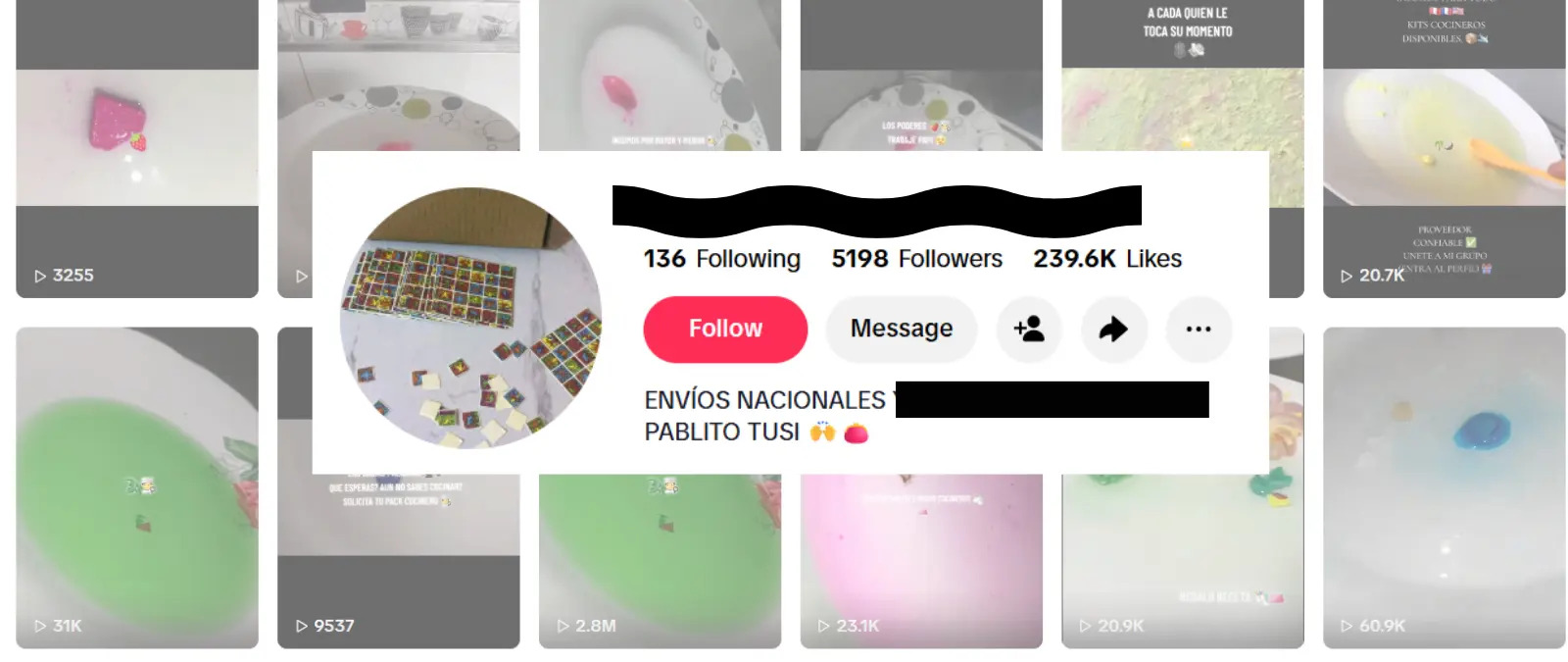
Detail of one of the profiles reported to TikTok that remain active

The investigation also shows how sellers use TikTok direct messages and applications such as WhatsApp Business and Telegram to contact potential buyers. They also rely on codes, alternative spellings, emojis, memes and references to popular culture to promote their products and attempt to circumvent the platform’s moderation systems.

Maldita.es also highlights the role played by TikTok’s recommendation system. During the investigation, content displayed on the “For You” feed and suggestions generated by the platform led researchers to new accounts, search terms and content related to the sale of tusi and other drugs.

The organisation reported more than one hundred accounts displaying, selling or producing drugs to TikTok. According to the investigation, the platform removed 15 specific videos reported as illegal content in the European Union, while the accounts that had published them remained active.

Maldita.es is a founding member of the IBERIFIER project.

Otros artículos

Maldita.es investigation uncovers thousands of predators accounts and videos of child sexual abuse on TikTok

An investigation by Maldita.es has uncovered more than 1,000 videos containing explicit child sexual abuse material on TikTok, which have accumulated over 48 million views. The analysis has identified a network of 26,000+ profiles...

Spain general election 2026: Weekly report no. 1 (2-6 Nov.)

On 2 November, IBERIFIER activated its Rapid Response System (RRS) of the EU Code of Practice on Disinformation for the election, and announced it publicly in a statement. The RRS will remain active until...

IBERIFIER comienza a monitorizar la desinformación electoral del 29N en el marco del Sistema de Respuesta Rápida europeo

El observatorio ibérico sobre la desinformación, impulsado por la Comisión Europea, alertará a las plataformas digitales sobre contenidos desinformativos que pongan en peligro la integridad de las Elecciones Generales PAMPLONA, 2 de noviembre.  El Observatorio...

Preliminary Report ahead of 2026 General Elections in Spain

by Aurken Sierra & Ramón SalaverríaUniversidad de NavarraNovember 1, 2026 Executive Summary Ahead of the General Elections in Spain on November 29, 2026, the IBERIFIER observatory is activating its monitoring protocol to analyze risks affecting public...

Preliminary Report ahead of 2026 General Elections in Spain

Ahead of the pre-electoral period for the general election on November 29, 2026, IBERIFIER observatory is activating its monitoring protocol to analyze risks affecting public debate. Spain enters this electoral process with public trust in news at 33%, while 74% of the population expresses concern about distinguishing true from false information online (Digital News Report 2026). This preliminary report synthesizes quantitative data from 8,086 fact-checks published between 2023 and 2026 by five organizations in the IBERIFIER Plus repository (EFE Verifica, Infoveritas, Maldita.es, Newtral, and Verificat). The document details key risk vectors: Foreign Information Manipulation and Interference (FIMI) operations using Spanish as a cross-border vector, generative AI, algorithmic bias (LLM grooming), news outlet impersonation (Doppelgänger), and opacity in private messaging channels. It also outlines responses under the Digital Services Act (DSA) and the hub's integration into the Rapid Response System (RRS, Measure 37.2 of the EU Code of Practice on Disinformation), active for these elections from November 1 to December 6, 2026.