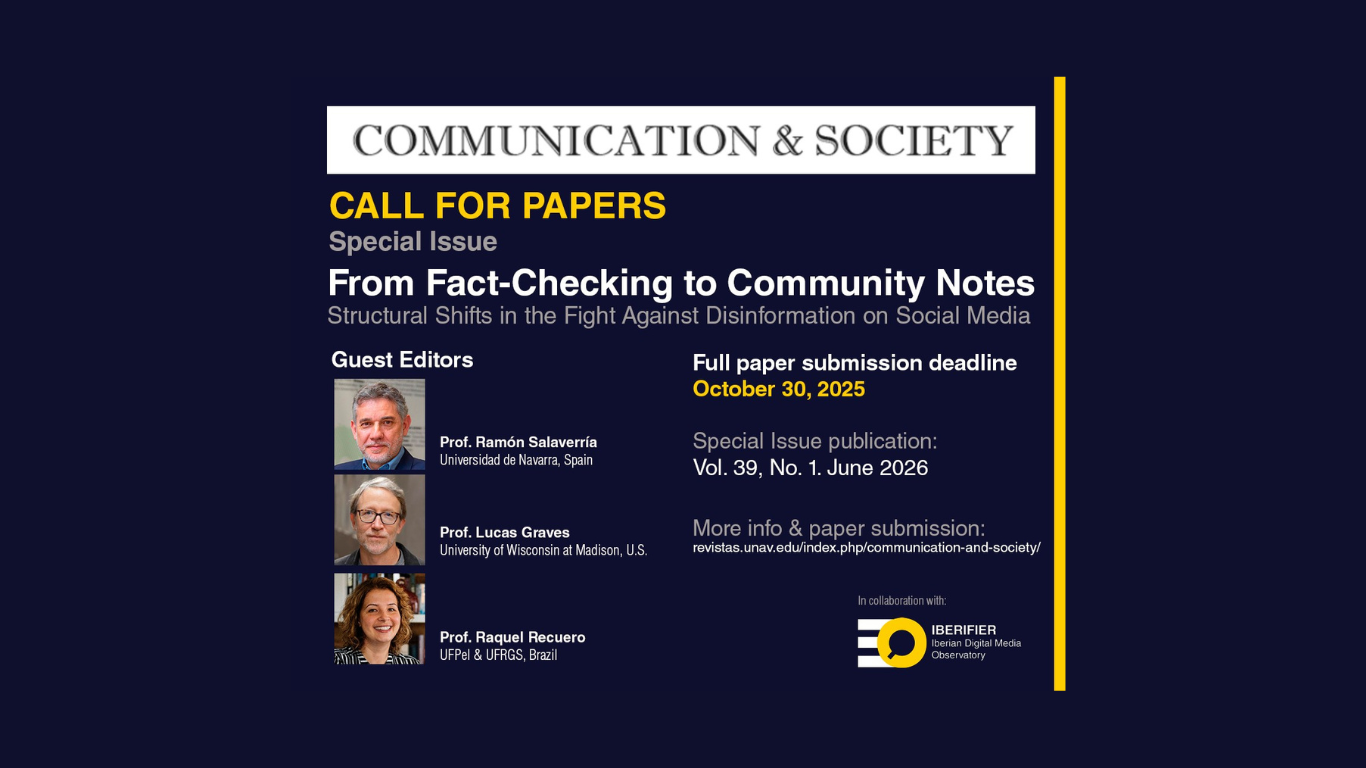
The journal “Communication & Society” will launch a special issue entitled “From Fact-Checking to Community Notes”. The submission deadline is 30 October. This is the submission platform. The guest editors are: Ramón Salaverría, University of Navarra, Lucas Graves, University of Wisconsin at Madison, US, and Raquel Recuero, UFPel & UFRGS, Brazil.
The Special Issue “From Fact-Checking to Community Notes: Structural Shifts in the Fight
Against Disinformation on Social Media” seeks to explore, from a scientific perspective, the
models, patterns, and outcomes of various content moderation approaches implemented by digital
platforms and, in general, to address the structural shifts in the fight against disinformation on
their social networks.
By examining professional fact-checking, community-driven verification
systems, and hybrid approaches, this issue aims to foster a deeper understanding of how these
strategies influence the spread of disinformation, user behavior, and societal trust. This special issue has the collaboration of IBERIFIER Plus project, co-funded by the European Commission.
Submissions will be accepted on the following topics, although other topics are also welcome: comparative analyses of third-party fact-checking versus community-based verification
systems; the impact of the shift away from third-party fact-checking partnerships on the global
field of fact-checking organizations; the role of platform algorithms in amplifying or diminishing the visibility of user verified content. Other examples: the impact of user-driven verification on misinformation diffusion and correction rates; patterns of engagement and user participation in Community Notes or similar initiatives; ethical considerations in transitioning from professional to collective content moderation models; the effectiveness of hybrid models combining professional and community input. More information.