
The dehumanisation of others is one of the techniques used in disinformative content

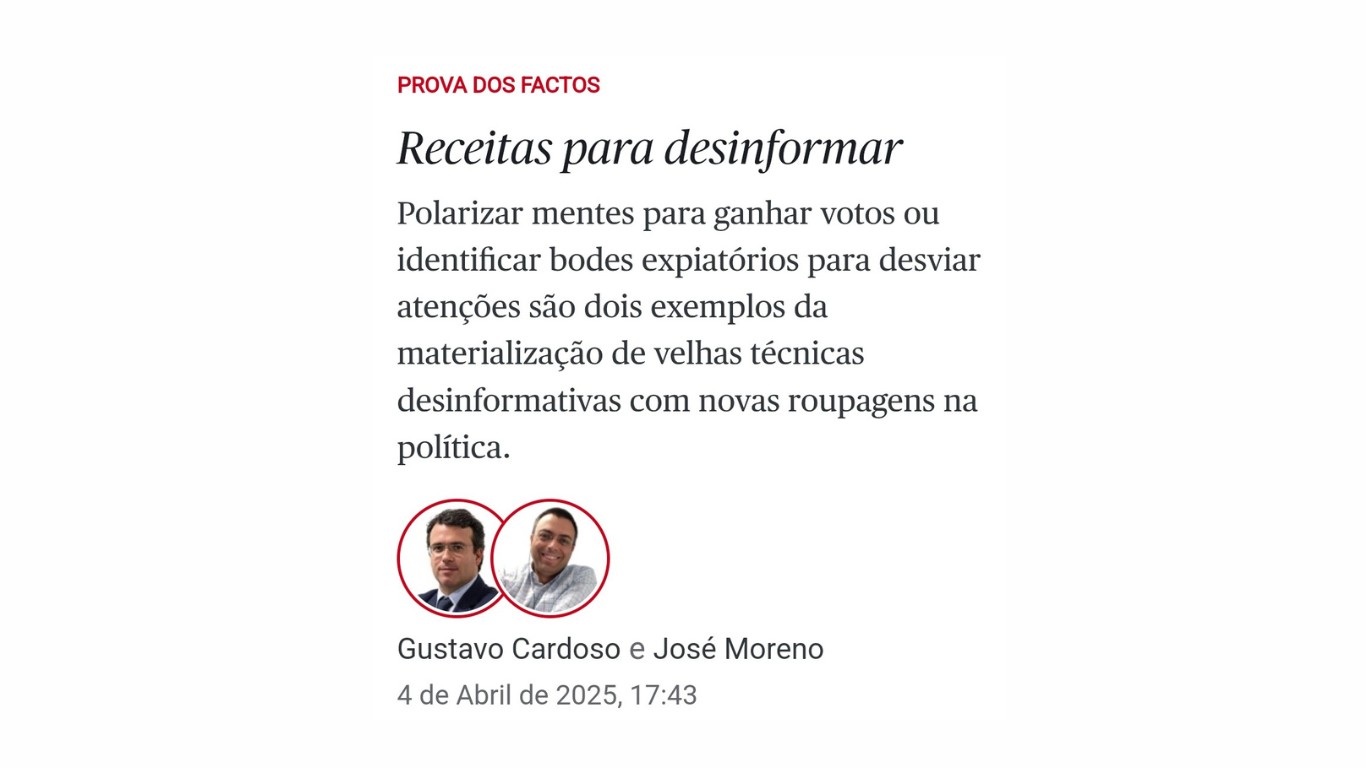
Researchers from MediaLab, ISCTE-IUL’s Media Laboratory, have analysed in an opinion article the main techniques being used by disinformation creators. In an article in the portugueses Público newspaper, Gustavo Cardoso and José Moreno point out that each country has its own topics of choice, but that immigration has become a cross-cutting issue. In common, there is a dehumanisation of the other.

The article, published as part of a collaboration between PÚBLICO and MediaLab, identified the disinformative narrative, repeated to exhaustion, that immigrants receive subsidies as soon as they arrive in Portugal. And depending on the country, different origins are chosen to denigrate.
In some countries, especially in Eastern Europe, the immigrants targeted by disinformation are Ukrainians fleeing war, in other countries it’s Turks or those from North Africa, in others, as in Portugal in recent months, it’s those from the Indian subcontinent – Bangladesh, Nepal, India or Pakistan.

Gustavo Cardoso is IBERIFIER’s coordinator in Portugal and José Moreno researcher at IBERIFIER.
All the article

Otros artículos

From fact-checking to Community Notes: new special issue examines the changing fight against disinformation on social media

The new special issue of the scientific journal Communication & Society, entitled “From Fact-Checking to Community Notes: Structural Changes in the Fight Against Disinformation on Social Media”, is now available. This special edition is...

Three IBERIFIER team projects shortlisted for the IFCN’s Global Fact-checking Awards

The projects "Noticias falsas, víctimas reales" by EFE Verifica, "Laura" by Newtral, and the research that looked into more than 1,000 fraudulent Facebook pages by Maldita.es, three organisations that are part of the...

Journalist Irene Larraz, a membre of the IBERIFIER team, has completed her PhD with a thesis on artificial intelligence and fact-checking

The growing use of artificial intelligence in content verification was the central focus of the research carried out by Irene Larraz as part of her doctoral studies, which she defended on 5 June at...

University of Navarra promotes a media literacy model based on real-world experiences and critical thinking

Through its School of Communication and its involvement in international projects such as IBERIFIER, the University of Navarra has been developing a range of initiatives aimed at strengthening citizens’ skills in analysing, verifying and...

Fake political endorsements, immigration and artificial intelligence shape a quarter marked by disinformation in Portugal and Spain

The dissemination of manipulated statements falsely attributed to presidential candidates and the circulation of alleged endorsements from public figures that never existed were among the main disinformation phenomena recorded in Portugal during the 2026...